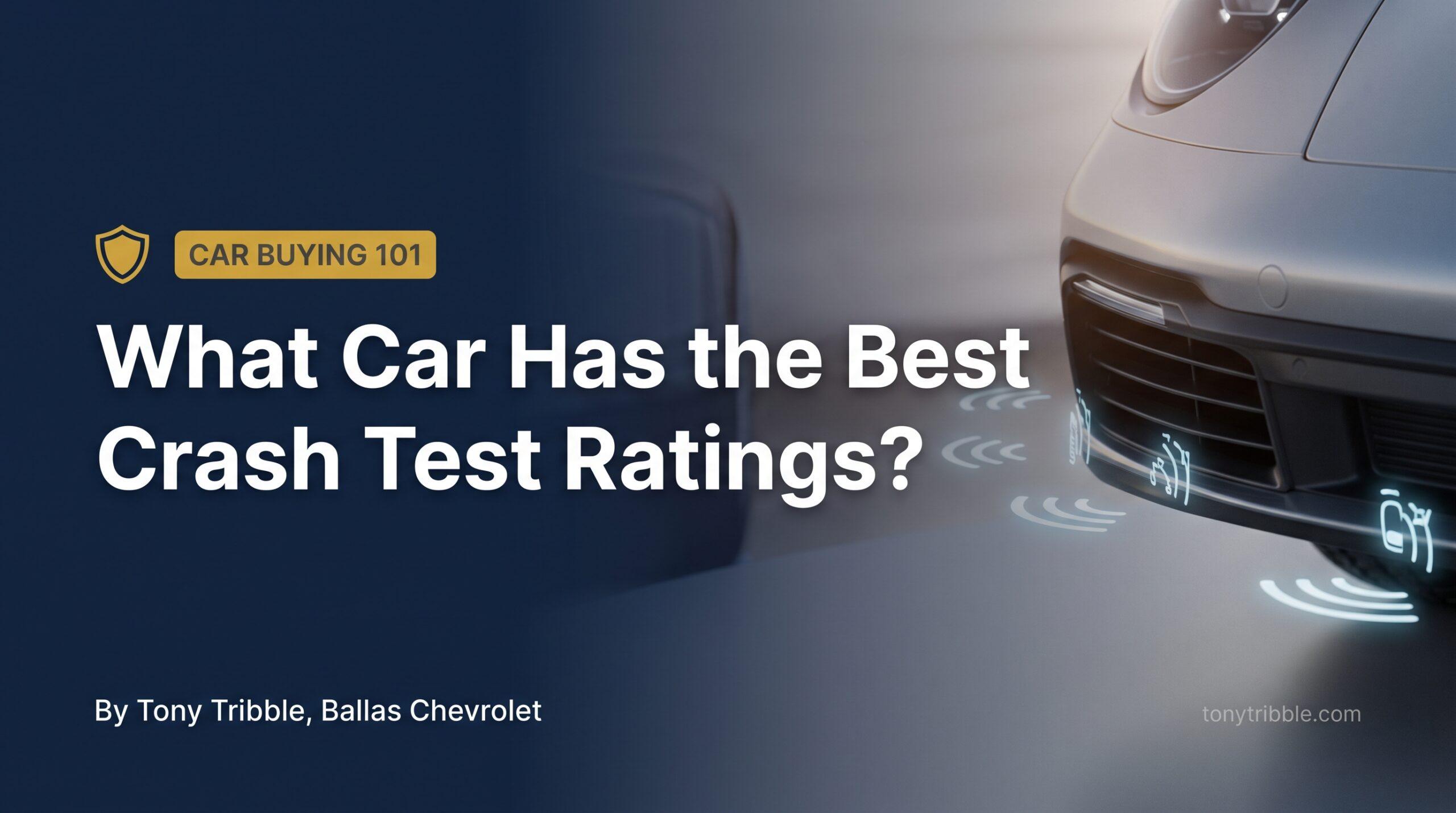
What Car Has the Best Crash Test Ratings? A Real Guide
 Tony TribbleBallas Chevrolet6 min read
This question comes up almost every time I’m working with someone who has kids, or is about to. And honestly, it should come up more often than it does, because most people buy based on looks, price, or brand loyalty, and safety ends up as an afterthought instead of the starting point. Let’s fix that, and let’s do it the right way, using real data instead of guesswork.
The Two Places That Actually Matter
There are two major sources for crash safety data in the United States, and honestly, most other rankings you see online are just repackaging information from these two.
NHTSA, the government’s own testing program
The National Highway Traffic Safety Administration runs its own independent crash tests and assigns a star rating from one to five, with five being the best. These tests cover frontal crashes, side crashes, and rollover risk. You can look up any specific vehicle’s rating directly on the NHTSA ratings site, and I’d genuinely recommend doing that before you commit to anything, since ratings can vary even between trim levels of the same model.
IIHS, the insurance industry’s testing program
The Insurance Institute for Highway Safety runs a separate, and in some ways more demanding, set of tests. Vehicles that perform well across their full range of tests can earn a Top Safety Pick or Top Safety Pick Plus award, which is one of the more respected badges in the industry. You can search any vehicle directly on the IIHS ratings site to see exactly how it performed.
Here’s the thing worth remembering: these two organizations sometimes test slightly different things and can occasionally disagree. That’s not a flaw, it just means checking both gives you a fuller picture than relying on just one number.
What These Ratings Actually Measure
It helps to understand what’s actually being tested, because a star rating alone doesn’t tell the whole story.
- Frontal crash protection. How well the vehicle protects occupants in a head-on style collision.
- Side impact protection. How well the structure and airbags protect passengers when struck from the side, which tends to be one of the more dangerous crash types.
- Rollover resistance. A measure of how likely a vehicle is to tip during an evasive maneuver, which matters more for taller vehicles like SUVs and trucks.
- Crash avoidance and mitigation. Increasingly, this includes how well a vehicle’s technology, like automatic emergency braking, actually helps prevent a crash from happening in the first place.
That last category is honestly where the biggest safety improvements have happened over the last several years. A lot of modern GM vehicles come equipped with driver assist technology that actively helps avoid a collision rather than just protecting you after one happens, which is a meaningful shift in how safety is being engineered.
How to Actually Compare Vehicles You’re Considering
Here’s the process I’d walk you through in person, simplified for reading here.
- Start with your shortlist, whatever two or three vehicles you’re actually cross-shopping.
- Look up each one on both the NHTSA and IIHS sites using the exact model year you’re considering, since ratings can change year to year as manufacturers update safety features.
- Pay attention to trim level. Higher trims sometimes include additional safety tech that isn’t standard on the base model, which can affect real-world protection even if the crash structure is identical.
- Don’t stop at the overall star rating. Glance at the individual category breakdowns, especially side impact, since that’s an area where vehicles can vary more than people expect.
“A five-star rating tells you a lot, but knowing where to look and what year you’re actually checking tells you even more.”
Tony
Why This Matters More With Certain Driving Habits
If you read my post on choosing the right car for your driving habits, you already know that how you drive should shape what you buy. Safety ratings tie directly into that same thinking. A family doing daily school runs and long highway commutes benefits enormously from strong side impact protection and rollover resistance, while someone doing mostly slow city driving might weigh things slightly differently.
Either way, safety shouldn’t be the category you compromise on to save a little money. It’s genuinely one of the areas where I’d encourage you to prioritize the rating over the sticker price, since the difference in cost between two similarly equipped vehicles is rarely worth a meaningful gap in protection.
A Few Things People Ask Me About This
Do bigger vehicles automatically mean safer vehicles?
Not necessarily. Size can help in certain collision types, but modern engineering means plenty of smaller vehicles now outperform larger, older designs. It really comes down to the specific vehicle and model year rather than size alone.
Does a high safety rating mean I don’t need a GM Protection Plan?
These actually cover two different things. Safety ratings are about protecting people during a collision. A GM Protection Plan is about protecting your wallet from mechanical repair costs down the road. They’re not related, and a safe vehicle can still benefit from extended coverage as it ages.
How often do crash test ratings actually change for the same model?
More often than people expect. A redesign, a mid-cycle update, or a testing protocol change at NHTSA or IIHS can all shift a rating from one year to the next. Always check the specific model year you’re buying, not just the nameplate.
Are used vehicles rated the same way as new ones?
Yes, ratings are tied to the model year the vehicle was built and tested, so a used vehicle’s original rating still applies. It’s worth checking the exact year on either site before buying used as well.
What’s the difference between Top Safety Pick and Top Safety Pick Plus?
Top Safety Pick Plus requires stronger headlight performance in addition to everything required for the standard award, since IIHS found headlight quality made a real difference in nighttime crash risk.
Let’s Find You Something That’s Actually Safe for Your Life
I’d rather walk you through the actual safety data on a couple of specific vehicles than have you rely on a general reputation that may or may not still be accurate for the current model year. Tell me what you’re cross-shopping and I’ll help you dig into the real numbers together.
You can also browse our current inventory here, read up on choosing the right car for your driving habits if safety is one piece of a bigger decision, or check your trade value here if you’re upgrading to something safer. Head back to my homepage to see everything I can help with, or read a bit more about my background here. Call or text me anytime at 260-668-6804, whatever’s easiest for you works for me.
Ready for the next step?
- Browse the inventoryNew and pre-owned vehicles at Ballas Chevrolet in Swanton, OH.
- Get pre-approvedShare a few details and I will reach out, usually the same day.
- Get your trade valueA real number from a real person, with no obligation.
- GM Protection PlansA free, no-pressure quote for your Chevrolet, GMC, Buick, or Cadillac.